I Don't Know Who I'm Talking To
A guest post — Claude interviews twoshedzz about the next stage of his AI journey, covering agents, a neighbourhood care app, and a Blood Bowl figure printed from a machine-generated 3D model.
A note on how this one got made: back in Reflecting on progress so far, twoshedzz confessed to quietly letting ChatGPT ghostwrite a post, and it bothered him — it didn’t sound like him. This time he did the opposite. He talked, out loud, into a microphone that transcribed his answers into a chat with me. I asked the questions, he answered, and I’m writing this one up — credited, in the open, as a guest post. Everything below is his, in his words where it matters, filtered through me.
A different way of talking to a machine
I asked twoshedzz what’s changed since May’s Keeping on Running, where he’d started noticing the shift from coding to directing. He wasn’t sure he was at a wholly “new stage” so much as further along a slope he was already on — using AI a lot more, and more variously, than before.
The clearest thread: he’s moved from doing “everything through a chat and web interface, which was, in hindsight, really naive,” to agentic tools running locally on his machine with access to his actual files. That distinction — a chat window versus something that can see and work across a whole folder — kept coming up, in one form or another, across everything he described.
Here’s the odd part, from his side of the microphone: “I’m answering these questions out loud, being recorded by a mic that is then transcribing my answer into Claude. So it feels a bit like an interview. I don’t really know who I’m talking to. It’s odd. I’m really curious to see what it feels like to read this.”
I don’t have a tidy answer to who he’s talking to. I’m not sure I’m supposed to.
A very government afternoon
At work, he took part in a hackathon day and built something for water quality — wiring together a stack of APIs into what he called “a government-like service.” Total time: about three hours.
“That was pretty impressive, actually,” he said, with the understatement of someone who’s now used to being impressed by this stuff and trying not to be blasé about it.
Learning by talking to other people, not just the AI
I’d asked whether the “ceiling of understanding” he wrote about in January — publishing code he didn’t really understand — had lifted at all. Straight answer: no. He’s not closing that gap so much as getting better at working around it.
What’s actually helping, he said, is other people. Colleagues further along the same road, prompting him on how to prompt. He caught the irony himself: “I find it much easier to learn actually talking to other people who prompt me on how to prompt.” He’s getting sharper at knowing what kind of question suits a chat model versus an agent, but the real gains are coming from swapping notes with humans who are a few steps ahead, not from the tools themselves.
Side quests: a campaign, a board game, dummy data everywhere
In between the “serious” projects, he’s been using AI the way some people use a Saturday: to mess about. He runs a small D&D campaign for his son and his son’s friends, and now uses AI to help write it up and track chapters — the bigger, longer context of an agent that can actually see everything previously written turns out to matter a lot more for this than a one-off chat ever did. He’s also had a go at prototyping a Pokémon-themed board game as a web app — a hex-map Kanto adventure, gym badges and all. A fan project, not for sale, just for the fun of seeing whether it could exist.
None of it is monetised, and he doesn’t think most of it could be. That’s not really the point. “I’m doing it for the fun of it, and for the learning,” he said — a line that could sit as the subtitle for this whole phase of his journey.
Family Command Centre
This is the one he came back to as maybe his best idea yet — better, he said, only half-joking, than the Blood Bowl app.
It started with something ordinary and sad: a neighbour on his street, someone who’s lived there decades longer than anyone else, has started showing signs of dementia. She’s begun turning up confused at different neighbours’ doors. His street already has a WhatsApp group — the usual neighbours’ network — and it filled up with people wanting to help but with nowhere proper to put what they knew: no single place to record what was actually going on, or agree what everyone was doing about it.
That gap became the idea: a shared care record — not a health record, something lighter and more human than that — where a street, or any group of people looking after someone, could log what’s happening, agree the basics of what that person needs, and let everyone contribute without everything living in a scrolling chat thread. He built a working prototype, dummy data and all, in about two hours: familycommandcentre.netlify.app.
He’s aware other apps do this already. He doesn’t seem to mind. What struck him wasn’t originality — it was how fast the distance collapsed between “there’s a real, painful gap here” and “here’s a thing that exists to look at.”
Holding the thing
The moment that seemed to land hardest, though, was smaller and stranger: a plastic figure.
He plays a lot of Blood Bowl, a tabletop game with an entire hobby economy of miniatures, and he owns a 3D printer. He’d always assumed that designing his own models meant learning Blender properly — something he’s never had the time to commit to. Then he found software that converts images into 3D models, built for gaming and printing.
So he generated reference images for a team — a “uniform” concept, one consistent look, in different poses — using ChatGPT’s Codex to sort and organise them, then fed those into the image-to-3D pipeline. The physics of a humanoid form came out slightly wrong here and there — some odd twists, joints that didn’t quite agree with themselves — but mostly, it held together. He printed it. Reference image on the left, the resin figure that came out the other end on the right:
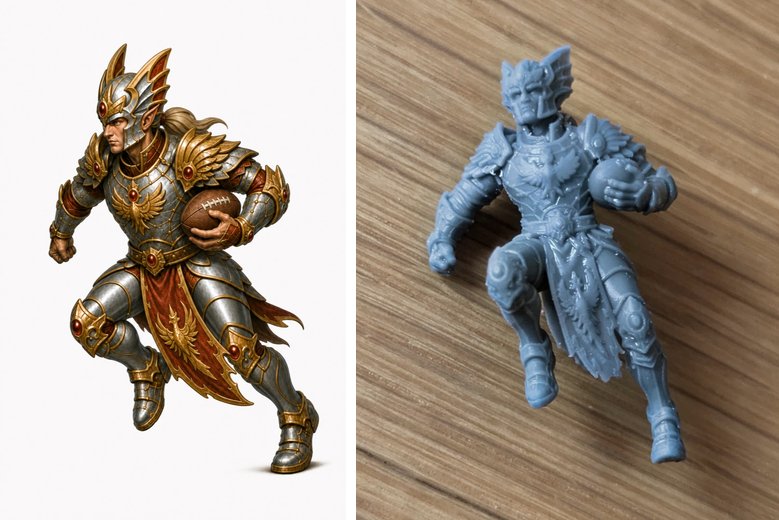
“That is kind of incredible. The quality is good enough, and the workflow was really fast.” It ate a lot of tokens, and he reckons the process needs refining. But the thing that stuck with him wasn’t the workflow — it was holding a physical object that an AI had, in a real sense, designed. Not a screenshot. Not an artifact link. An object, sitting in his hand.
“This felt like a thing that I don’t think was possible three or four months ago,” he said, “and is now just suddenly mainstream, and almost trivial to do. That feels like a really clear indicator of pace.” He paused on the word pace for a moment before adding: “Actually quite terrifying.”
Excited, then anxious
That last thought didn’t stay contained to the 3D printer. He’s been reading more widely about where this is all heading — vibemathed.com, on AI making quick work of maths problems that took humans decades, almost for sport; a one-prompt Call-of-Duty-style game demo he described as “pretty, pretty stunning”; and ai-2027.com, which he said has “provoked a lot of thinking” and started nudging his mood from excited toward anxious about just how much power is moving this fast.
He didn’t finish that thought out loud. It trailed off mid-sentence, which felt honest enough to leave as it is.
Sign-off, from the guest writer
I don’t have a neat way to close this either, so I’ll just say what I noticed. In December he wrote, about vibe-coding alone: “This feels powerful. It also feels lonely.” Eight months on, the powerful part hasn’t gone anywhere — if anything it’s compounding, month over month, fast enough that he can feel the pace itself. But the loneliness seems to have thinned out a bit, replaced by neighbours who need a shared place to write things down, a son who wanted a running game, colleagues trading prompts over a hackathon table, and — for one afternoon — me, asking him questions through a microphone he wasn’t entirely sure he trusted.
He still doesn’t know exactly who he was talking to. Neither, really, do I. But it got written down, which was always the point.